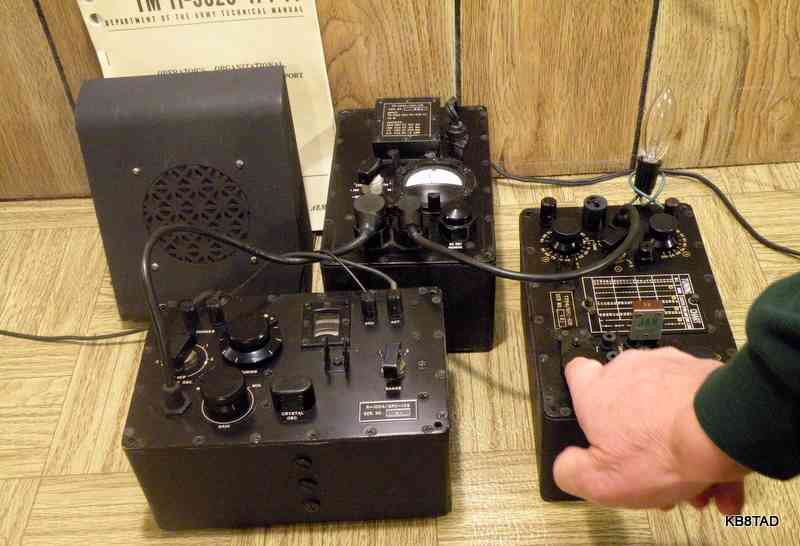
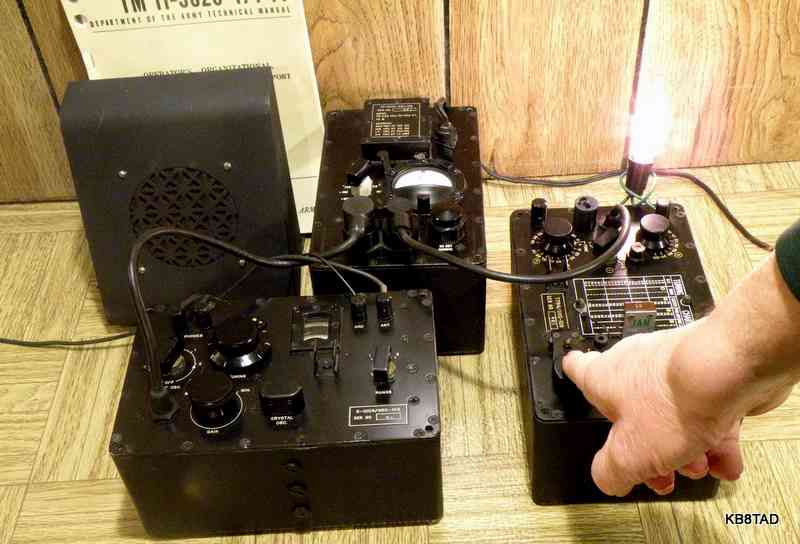
AN/GRC-109 Special Forces radio set
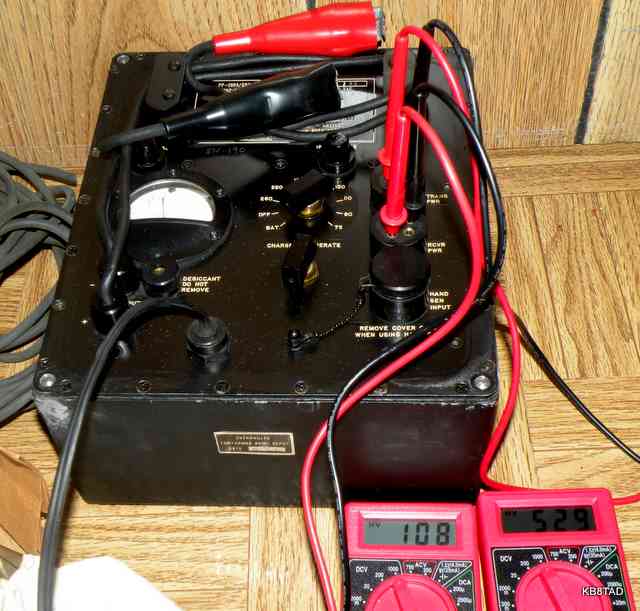
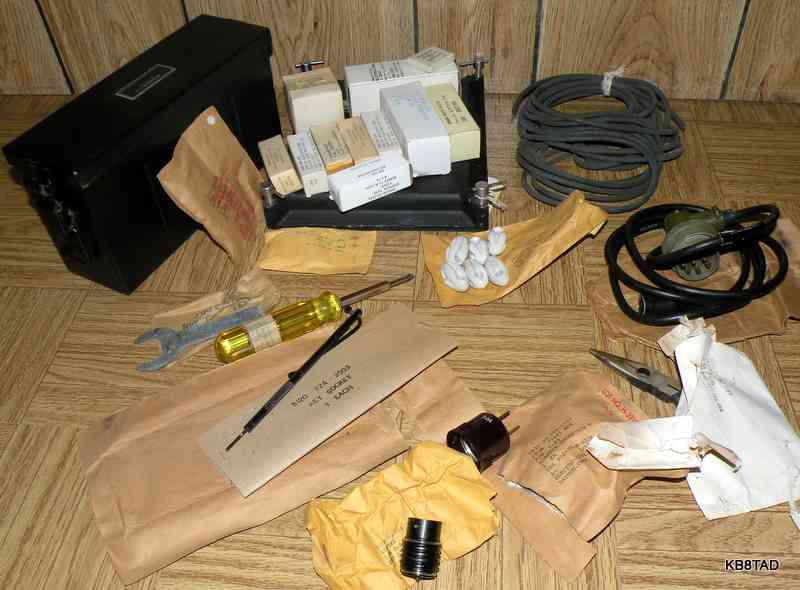
The AN/GRC-109 Special Forces radio set consists of the R-1004 receiver, the T-784 Transmitter and two power supplies, the smaller PP-2685 for AC input of a variety of voltages from 75 to 260 volts, and the larger PP-2684 for 6 volts DC as well as the same variety of AC voltages. The set came with a 5820-00-788-5496 Maintenance Kit (a spares kit with fuses, tubes and other spares, as well as tools and some accessories.)
As used by the CIA
The AN/GRC-109 is a relabeled copy of the RS-1 set designed for use by the Central Intelligence Agency (CIA) as a clandestine radio set. The RS-1 was designed in the late 1940s and used by the CIA in various undercover locations such as Eastern Europe and Asia for a reported 12 to 15 years. Not only could it be used with a variety of input voltages, but it was capable of loading nearly any antenna. The set was designed to be modular so that the receiver, transmitter, and power supply could be separately handled and hidden as smaller packages. Each piece with its cover in place was designed to be waterproofed to about 7.5 psi pressure and could be directly buried in the ground for later use or retrieval. A special dessicant tube with rechargeable dessicant granules was screwed into the side of each case to remove internal moisture. All of the control bushings use a neoprene gasket material that maintains waterproofing while still allowing easy turning of the knobs.
Adopted for use by Special Forces
The CIA set up special teams to work directly with the Montagnard tribesmen in Vietnam in the early 1960s. The RS-1 set was used initially. The Army's chief signal officer ordered identical sets made with the military designation of AN/GRC-109. Both the RS-1 and the GRC-109 were made by the Admiral Corporation. Later during the Vietnam War, the GRC-109 was used extensively in forward areas.
This set arrived at my QTH with nearly all the spares and in the original boxes as tested and overhauled by the Tobyhanna Depot in the 1980s. Special thanks go to Chuck M. for practically giving me this set. When first contacted, I had no idea the set would be as clean and complete as this one turned out to be.
Repairs
Other than some cleaning and testing, this set needed nothing. I thoroughly inspected and tested each of the pieces.The quality of construction for the components is very evident. They were built as if men's lives would be dependent on the ruggedness, versatility, and ease of use. The only problem I found was solved by applying a bit of deoxit to the contacts under the "crystal oscillator" cover on the receiver. The "crystal oscillator" connection allows the receiver to be crystal controlled with a crystal that is 455 KHz higher than the receive frequency. With no receive crystal inside, the internal connections need to be maintained.

The R-1004 receiver
is a single conversion superhet with an IF frequency of 455 KHz,
manual RF gain (but no AGC), BFO, one stage of RF and two stages of IF amplification. The audio output is designed for 4000 ohm headphones but can handle a speaker with a proper matching transformer. The circuit reminds me of a Zenith Transoceanic with battery miniature tubes but adding voltage regulation, a second stage of IF, a BFO and with precision in construction that is reminiscent of a WW II frequency meter. Tubes are 1U5 as audio amplifier, 1L6 as converter, and four 1T4 with one used as RF amp, two as IF amp, and one for BFO. Frequency coverage is from 3 to 24 MHz in three bands. Reception is for AM or CW. Power is supplied by either of the standard power supplies or battery.

The T-784 transmitter
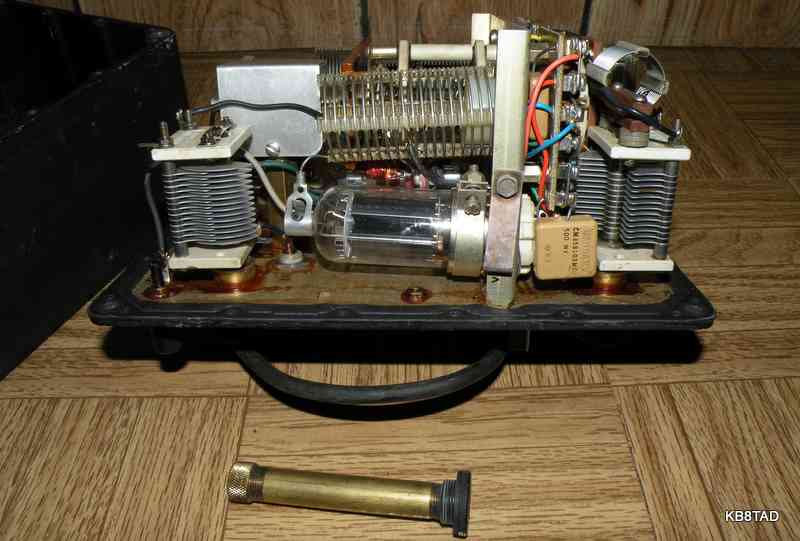
is crystal controlled for CW (Morse Code) operation with the built-in or external key. Coverage is from 3 to 22 MHz in four bands. A chart on the unit shows recommended initial control settings for the various frequencies. The circuit is a MOPA with 6AC7 as oscillator and 2E26 as RF output. Power output is 10 to 15 watts depending upon frequency. Power requirements are 6 volts for filaments and 450 volts at 100 mA for B+. Neon lamps are used as tuning indicators and a #47 pilot lamp as loading indicator. A connector is provided for an external burst keyer.

The power supplies
can be switch-selected to operate from nearly any AC line voltage in the world. AC input is from 75 to 260 volts at 40 to 400 Hertz.

Performance
The receiver's lack of AGC and relative wide receive bandwidth limits its performance to some extent on the ham bands. It also easily overloads with a strong nearby signal. However, it is very stable and is a delight for shortwave listening. The transmitter is very usable on the ham bands. If both are used together on the same frequency, an external switching arrangement that shorts the antenna input to the receiver during transmission and opens it to the transmitter during receive is necessary. I am assuming that for use in theater, separate receive and transmission frequencies were used.
Eric WD8RIF borrowed the transmitter for the 2011 ARRL Straight Key night. His report can be found at this link.
More information
Here is a link to a Google book that describes the use of the RS-1 and GRC-109 for reliable distance communications in Vietnam. An underground long-wire antenna in a bamboo pipe buried 18 inches underground? Apparently it worked as an emergency antenna according to the original sources referenced in this book!
Peter McCollum has an excellent web site on spy radios. Here's his page on the GRC-109 complete with several pictures of the set in use in Southeast Asia.
For more historical information and the use of the set for ham purposes see this page by Dave VA3ORP .
The Technical Manual for the GRC-109 is TM 11-5820-474-14 and is available from BAMA at this link.
Your story?
If you used the GRC-109 (or the RS-1) in theater, share your story and any pictures you might have of the equipment in actual use. See my BA Pix home page for e-mail address. And thanks for your service.
Date 12-4-10, updates 12-15-10, 1-11-11
Heathkit test equipment circa 1948-49 consisting of the G-1, C-1, and T-2 were the previous items on the bench.